
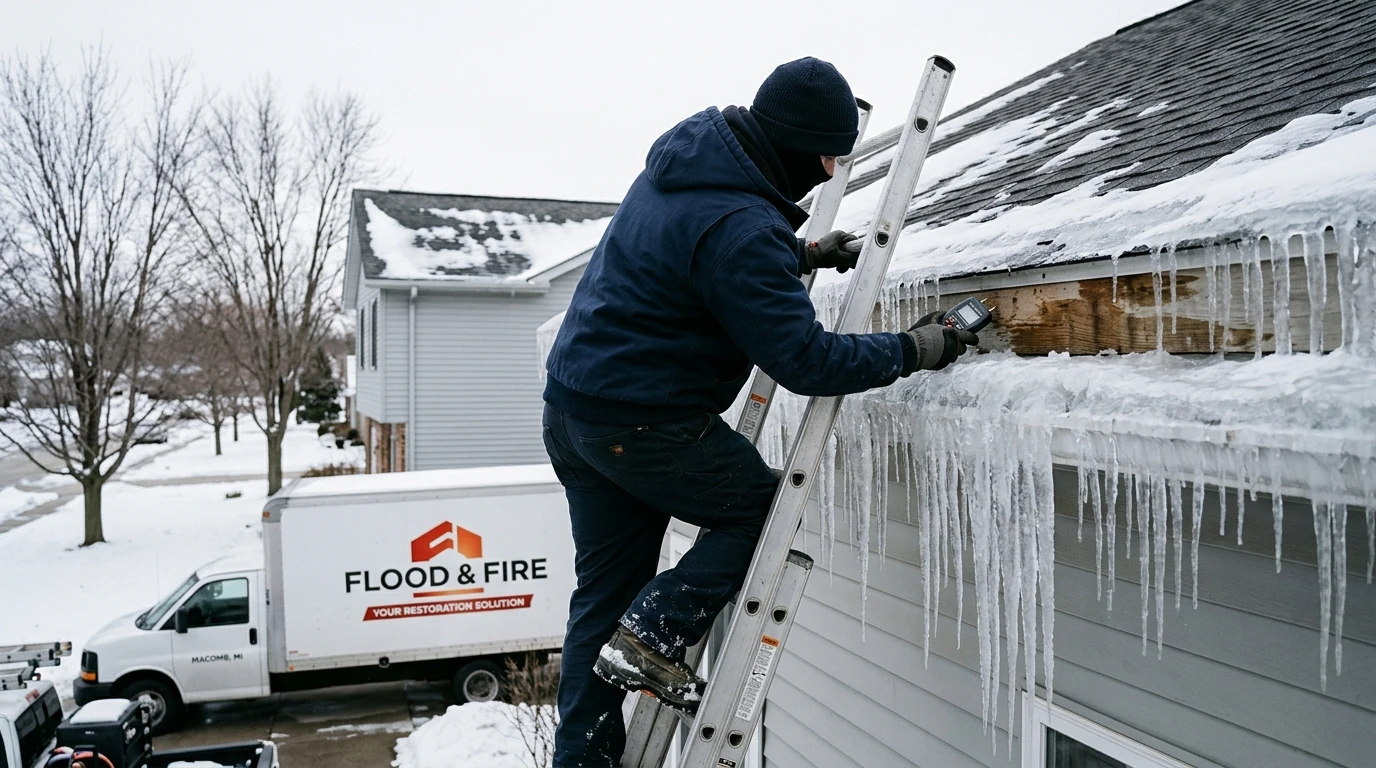
TL;DR: The best ice dam water damage restoration company in Macomb uses low-pressure steam (never a hammer or hot water) to remove the dam, maps moisture in the attic and ceiling before drying starts, documents everything for your insurance adjuster, and gives you a written scope that separates ice dam removal from water extraction and ceiling repair. Ask about all four before you sign anything.
If you’re reading this with a bucket under a brown stain spreading across your dining room ceiling, you’re probably dealing with an ice dam: snow melts off a warm roof, refreezes at the cold eave, and backs water up under the shingles. That water doesn’t stay in the attic. It travels along rafters and insulation until it finds a light fixture, a soffit, or a ceiling seam and drips through. Macomb and Ira Township see this every winter when daytime sun and overnight temperature swings hit a roof with uneven insulation. Picking the right company matters because the damage is usually in two places at once, your roofline and your interior, and a company that only knows one half of that job will leave you with a second problem.
How should an ice dam be removed from the roof?
It should be removed with low-pressure steam, not a hammer, axe, hot water, or rock salt. Steam melts the ice without cracking shingles, denting flashing, or forcing water further under the roof deck, which is exactly what happens when someone attacks a dam with a mallet or pours hot water on it.
When you call a company, ask directly: “Do you use steam, or something else?” If the answer is anything involving a chisel, a pressure washer, or de-icing salt thrown on the roof, keep calling. Salt and calcium chloride can also stain siding and kill landscaping below the eave line.
Why does moisture mapping of the attic and ceiling matter before drying starts?
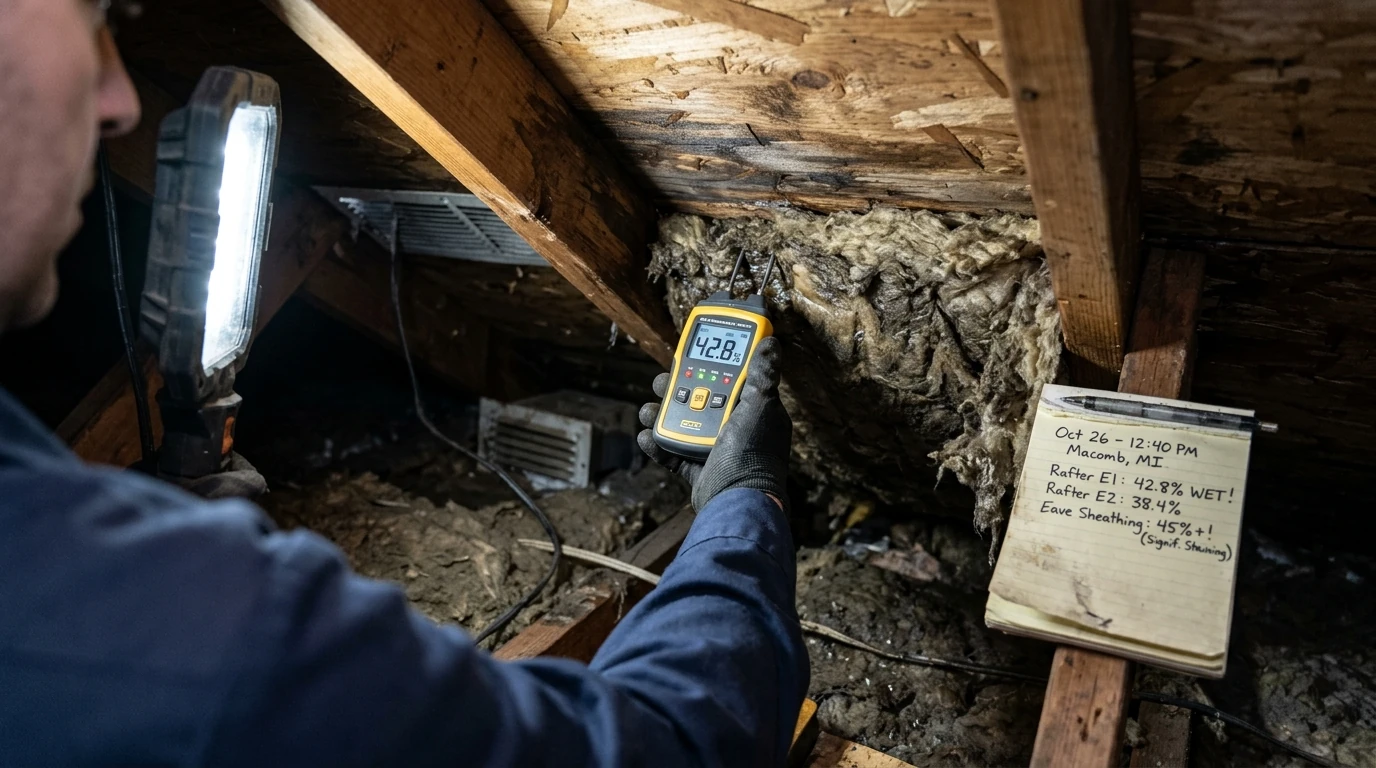
Moisture mapping tells the crew exactly how far the water traveled before they open up a single piece of drywall. Ice dam water rarely stays where it first appears; it runs along the underside of the roof deck and down top plates, so the stain on your ceiling is often smaller than the wet area above it.
A company doing this correctly uses a moisture meter (and often a thermal camera) to check the attic insulation, the roof sheathing, the top plates, and the ceiling drywall in a grid pattern, then writes down the readings. That record becomes the basis for how much insulation gets pulled, how many air movers and dehumidifiers go in, and how long drying runs; without it, a crew is guessing, and guessing means either wasted equipment time or a hidden pocket of wet insulation that grows mold weeks later.
Drying follows the ANSI/IICRC S500 standard for professional water damage restoration, which sets the benchmark for when a structure is actually dry versus just dry to the touch. Ask whether the company dries to documented moisture-content targets or just “until it looks dry.”
What should the insurance documentation look like?
It should include dated photos of the ice dam and interior damage, the moisture-mapping readings, and a written scope before any demolition starts, because that paper trail is what your adjuster uses to approve the claim. Most homeowners policies in Michigan treat sudden water intrusion from an ice dam as a covered peril, since it’s sudden and accidental rather than a gradual leak, but coverage specifics vary by policy and by insurer, so confirm the details with your agent or the Michigan Department of Insurance and Financial Services.
A company that’s used to this kind of claim will photograph the roof before removal, photograph the wet materials before they come out, and hand you (and your adjuster) a written scope that itemizes the ice dam removal, the water extraction and drying, and the ceiling and drywall repair as separate line items. That separation matters because adjusters evaluate each category differently, and a vague one-line invoice slows down approval.
Does the company actually answer the phone during a Macomb winter storm?
A real emergency crew answers around the clock, because an ice dam leak doesn’t wait for business hours and the longer water sits in insulation and drywall, the worse the damage gets. Flood and Fire Solutions has operated in Macomb and Ira Township since 1996 and runs a 24/7 line at (586) 580-0197, so when a ceiling starts dripping at 11 p.m. during a January thaw, someone picks up.
Before you commit to a company, ask what happens if you call at 2 a.m.: do they dispatch, or does it go to voicemail until morning? For an active leak, that answer changes how much damage you wake up to.
What questions should you ask before hiring anyone?
Ask these five questions and listen for specific answers, not reassurance: (1) Do you remove ice dams with low-pressure steam? (2) Will you map moisture in the attic and ceiling before you start drying? (3) Will I get photos and a written scope for my insurance adjuster? (4) Do you answer calls 24/7, and who actually shows up? (5) Is the removal, drying, and ceiling repair broken out as separate line items, or one lump sum?
A company that hedges on the steam question, skips moisture mapping, or won’t put the scope in writing is one you want to avoid during an active leak, not after. For more general questions worth asking any restoration company before you sign, see our guide on choosing a restoration company in Macomb.
Flood and Fire Solutions is locally owned and operated, licensed and insured, and has served Macomb, Ira Township, and the surrounding communities since 1996. If you’re also comparing general water damage companies, not just ice dam specialists, our breakdown of water damage restoration companies in Macomb covers that broader comparison.
If you’ve got an active ice dam leak right now, don’t wait for a second storm to make the decision for you. Call Flood and Fire Solutions at (586) 580-0197 for a free consultation; a technician can walk through the roof and ceiling assessment with you and tell you exactly what’s involved before any work starts.